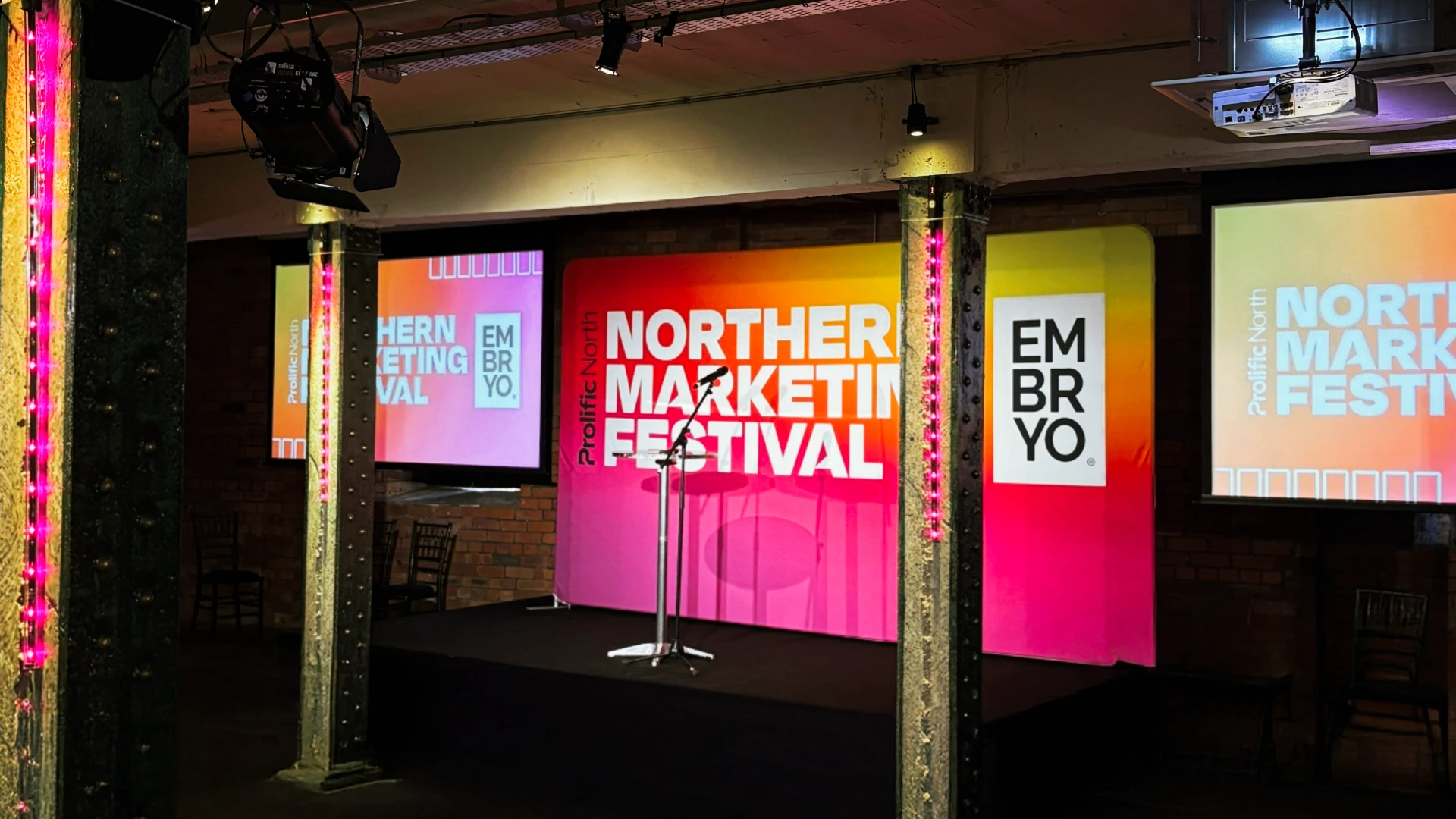
Two of our team spent the day at the Prolific North's marketing festival in Manchester, sitting through session after session, taking notes and arriving at the end of it with the same feeling: most of what we heard confirmed things we already believed and a handful of it sharpened them considerably.
In a year where every conversation defaults to AI, there was something steadying about a room full of marketers who kept landing in the same place: the fundamentals still win, brand matters and emotion drives decisions. As always, it’s important to do the thinking early as it saves you from undoing bad work later. Overall, the key take away was that the channels keep moving but the principles don't.
Read below on what landed with the team and what we think it means.
Jess Atkinson, Organic Search Director, at Embryo, opened the day with a reframe that cuts to the heart of something we've been saying for years. On a crowded results page, people scroll past brands they don't recognise even when those results rank well. Familiarity and trust do the work before a single click happens.
This goes beyond just a search insight, it’s the importance on brand awareness. The reason brand investment is so hard to sell to growth-stage B2B businesses is that its effects are diffuse and delayed. Jess was able to pinpoint this - if people don't recognise your name, your ranking is irrelevant. Brand recognition is a multiplier on every other channel; paid, organic, referral, basically everything.
A panel hosted by Fergal O'Connor of Buymedia, with contributors from Print.com, Citipost Mail, Bauer Media and Sky, named something that too many marketing plans still refuse to acknowledge. Print never truly left the scene - direct mail is making a comeback. The marketers seeing the best results are the ones who have stopped treating channels as separate conversations with separate budgets and started focusing on a well throughout multi-channel campaign.
The honest answer to "what should be in our media mix?" is almost never to add more digital, but it’s where your audience is actually paying attention. We push clients on this in our Discover phase, not because we have a channel agenda but because the evidence sometimes points somewhere more interesting than the default.
Dmitry Bastron from Byteminds made a point that will reshape how a lot of agencies talk to clients about digital builds. As Dmitry confirmed, you can vibecode a website in two hours. The harder question, the one that determines whether the investment was worth it, is what your marketing team can do with it once it's live. Can they run campaigns, personalise content and prove what's working?
The CMS market is moving fast and the distinction between "content management" and "AI-powered marketing operations" is disappearing. The best platform in 2026 isn't the one with the nicest interface, it's the one with the most capable agent. We're already asking this question during our Develop phase, but Dmitry's framing sharpened this point for us considerably.
Eleanor Barker, CMO, at Lipton Teas & Infusions, walked through the return of the PG Tips Monkey, and made a genuinely compelling case for the commercial value of emotional brand assets. The Monkey wasn't brought back out of sentimentality. It was brought back because it owned a feeling that no amount of new creative could easily replicate.
Established businesses often have dormant brand equity they've stopped investing in - assets, associations and reputations that carry real commercial weight. The instinct, particularly at growth stage, is to modernise everything. Sometimes the smarter move is to understand what you already own before you discard it.
Bill Dennett from Uber Advertising made a point that sounds obvious but rarely gets acted on: the brands people keep coming back to aren't the ones with the best loyalty programmes, they're the ones that are genuinely useful. Stop competing for attention, when you can become the answer to a real consumer problem.
This matters enormously in B2B marketing. Long sales cycles mean brand perception is being formed long before a buyer is in market. The businesses that win aren’t the ones that are the loudest, but the ones that have been consistently relevant. Relevance is earned through positioning, content and reputation. It's not bought through incentives.

Ben Cunningham and Ben Ducker from IMA were refreshingly candid about the media and creative relationship. It involves compromise, communication and it won't always produce the work you imagined on paper. But when the creative is built to travel through the right channels, and the channel thinking has shaped the creative from the start, the connection is what makes it work.
This is something we've seen hauled out repeatedly. Clients who treat brand, content, and distribution as a joined-up system consistently outperform those who brief them separately.
Andrew Holland from JBH PR introduced a framework we think will become standard vocabulary quickly: FAME x FITNESS = probability of being chosen. In an AI-mediated search environment, rankings matter less than recommendations. Being cited by a language model is increasingly as valuable as appearing on page one, and it requires the same underlying work: be known, be credible, be consistently useful.
This reframes a lot of how we think about thought leadership and content strategy for B2B clients. The brief was already "create content that builds authority." Now the measure of success includes whether that content is being surfaced and attributed by AI. The standard has risen, yet the principle has stayed the same.
Hannah Craig and Lauren Henley, from Impression, mapped the fragmentation of modern search across social, search engines, AI and what it means for campaign design. The phrase that stayed with us throughout this session was - design for unrestricted visibility.
Campaigns can't be channel-specific anymore. They need to generate clear, consistent, structured signals that travel across platforms, so that AI can understand and summarise. It's not a radical departure from good content strategy but it does raise the bar on clarity, consistency and structure. Vague, loosely attributed content gets lost, whereas specific, well-sourced and clearly positioned content gets cited.
Rebecca Lott, Commercial Director at Co-op Live, closed the day with a perspective drawn from one of the most ambitious venues launches the UK has seen. The insight ran wider than just events, it touched on the audiences that brands want to reach whether that be fans, customers or clients. Rebecca spoke on the consumer desire for authenticity, seamless experiences and evidence that you mean what you say. People can tell the difference between genuine engagement and automation dressed up as it.
In B2B, where trust cycles are long and reputations are hard-won, this matters as much as anywhere. Brand promises need to be present at every touchpoint, throughout the client’s experience. The gap between what a business says it stands for and what clients actually experience is where brand value gets lost. Closing that gap is strategic work and not poor marketing’s version of window-dressing.
Across nine sessions and a full day of conversation, a few things kept surfacing:
None of that is new thinking. But it's thinking that too many businesses still treat as secondary to the next campaign, the next platform or the next technology. The marketers in that room on Thursday weren't chasing shiny objects, they were doing the harder, more valuable work of getting the fundamentals right.
That's exactly the approach we take with clients at WDC Brands, and it was good to spend a day with people who think the same way.
If the themes from Manchester are live questions in your business; brand recognition, media mix, campaign structure, AI visibility, or simply getting a brief that sets the work up properly - we're happy to talk it through.
WDC Brands is a B2B brand strategy and marketing agency based in Manchester. We've worked with established businesses in professional services, financial services and technology for 25+ years, across 500+ projects. We work with founders, MDs, and senior marketing leaders at moments of growth and change.
Get in touch. No obligation, no agency pitch. Just a straight conversation about your business.
Created on
May 29, 2026
Last updated on
June 3, 2026