.webp)
Modern websites are increasingly expected to be both visually impressive and technically fast. Brands want immersive animations, high-quality imagery, and engaging interactions, yet performance tools such as Google Lighthouse and PageSpeed Insights often penalise these same design choices.
The challenge is to navigate a pathway between delivering strong brand-driven digital experiences and ensuring websites remain fast, accessible, and optimised for search engines. The right approach isn’t about chasing perfect performance scores, it’s about aligning design, performance, and business goals.
In this article, we explore what performance metrics really measure, why visually rich websites often score lower, and how businesses can strike the right balance between speed and impactful design.
Websites that feature large high-quality images, full-screen animations or video, and complex interactions and transitions tend to perform worse in lab-based testing tools like PageSpeed Insights or Lighthouse.
Performance tools deliberately test websites under more challenging conditions. They simulate slower mobile devices and artificially limit the internet speed, known as throttling, to mimic users on weaker connections, such as 3G or congested public Wi-Fi. Under these artificial conditions, rich visuals naturally take longer to load and render.
As a result, visually engaging sites often appear slower in synthetic tests, even when real users experience fast and responsive performance.
Performance tools focus heavily on Google’s Core Web Vitals, including:
These metrics are extremely useful for spotting genuine usability problems, especially for users on slower devices or networks.
However, they don’t fully capture emotional impact, brand perception, or engagement driven by immersive design.
For example, a full-screen hero animation or video may negatively impact LCP but significantly improve user engagement and first impressions.
This highlights an important reality: performance tools optimise for technical efficiency, not always for branding or storytelling.
Global brands with high-performing websites illustrate this disconnect clearly.
Websites from well-known companies often record moderate PageSpeed Insights / Lighthouse scores (typically 40–70) on mobile and desktop.
For example, as of 26/02/2026, reported Lighthouse performance scores (Mobile / Desktop) include Apple (56 / 88), Adidas (41 / 62), Toyota (26 / 50), Vodafone (38 / 43), and BBC (26 / 57).
Despite these lab-based scores, many of these sites still pass Google’s Core Web Vitals, as measured using real-user field data.
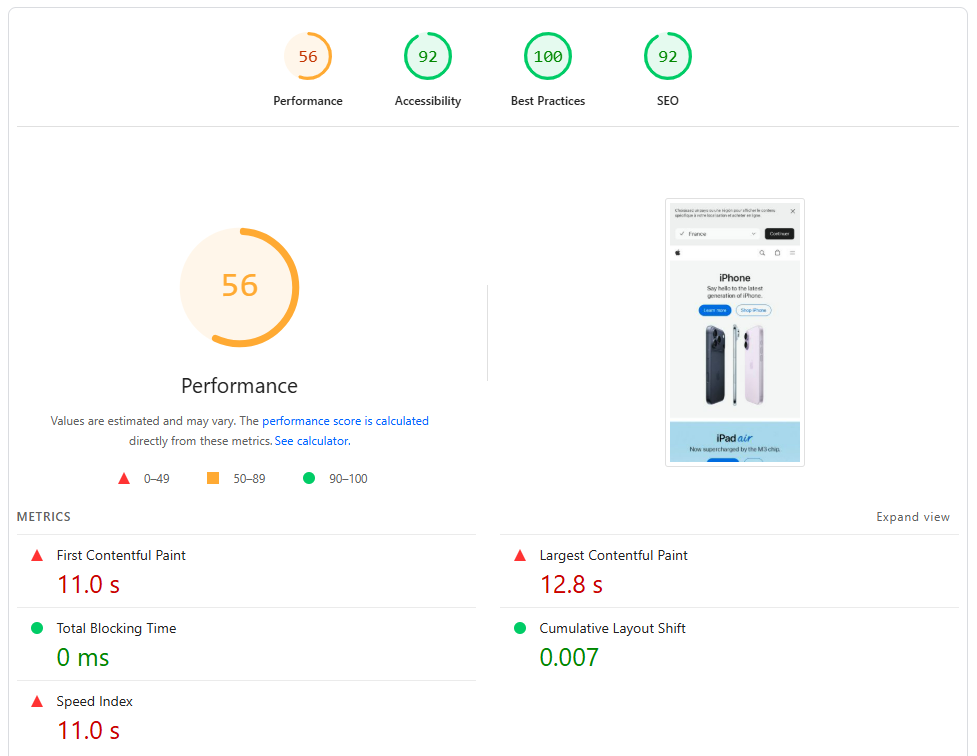
These brands invest heavily in optimising what matters most, such as layout stability, perceived speed, and responsiveness, while continuing to use rich visuals and media-heavy layouts that support their brand identity.
Lab tools penalise these design choices because of simulated throttling but real users with modern devices typically experience fast, smooth websites.
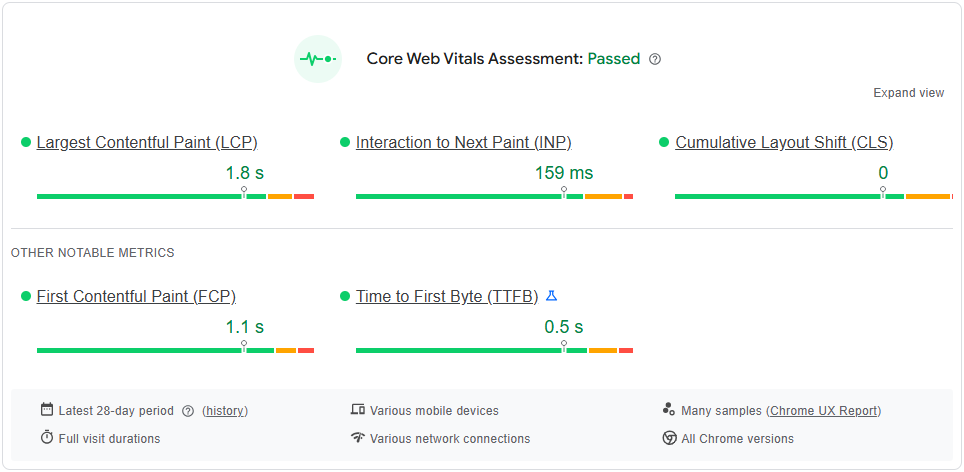
Aiming for a perfect 100 out of 100 performance score is rarely necessary and often counterproductive.
The difference between a score of 90 and 100 usually represents tiny technical improvements that most users will never notice, an example of diminishing returns when it comes to performance optimisation. Achieving that last 10 percent often requires removing animations, reducing image quality, or simplifying layouts in ways that can weaken branding and engagement.
For many brand-focused websites, the goal isn’t maximum speed at all costs. It’s about creating a memorable experience while maintaining strong real-world usability.
Large brands can afford this balance because images are cached after the first visit which speeds up subsequent page loads. Many users visit their site intentionally, as they know what the brand offers, so they are less likely to bounce and already have high search authority. However, this strategy doesn’t apply equally to every business.
For newer businesses or those with limited online presence, performance plays a much bigger role in discoverability.
Google uses performance as a ranking factor, and users are far more likely to leave slower sites when they don’t yet trust the brand. Unlike global companies, smaller businesses don’t benefit from high brand recognition or authority.
But this doesn’t mean engaging design should be sacrificed entirely.
Search rankings depend on many factors, including content quality and relevance, user experience, site structure and SEO fundamentals, and performance metrics.
A faster website alone won’t outrank strong content, but poor performance can hold a site back, especially in competitive markets.
The key is finding a balance that supports both SEO growth and strong brand presentation.
There is no single correct way to balance performance and design. For example, luxury or premium brands may prioritise immersive visuals and storytelling, whilst lead-generation websites may lean more toward speed and clarity, and content-heavy sites may require stricter performance optimisation for SEO.
Each strategy should be shaped by target audience, brand positioning, growth goals, and competitive landscape.
The secret is to assess these factors before making technical and design decisions, rather than blindly optimising for tool scores.
Creating websites that are both visually engaging and technically optimised is entirely achievable with thoughtful planning.
Some of the approaches we use at WDC Brands include using modern image formats such as WebP and AVIF, intelligent compression and asset optimisation, prioritising above-the-fold content loading, minimising unnecessary scripts and animations, and optimising Core Web Vitals without sacrificing creativity.
By making strategic design and development choices, we help clients achieve fast real-world performance, strong SEO foundations, and engaging brand experiences.
Performance tools like Lighthouse and PageSpeed Insights are valuable, but they shouldn’t be treated as the sole measure of a website’s success.
Visually rich websites may score lower in synthetic tests yet still deliver excellent real-world usability and engagement. Meanwhile, simpler designs may achieve higher scores but lack the emotional impact needed to stand out in competitive markets.
The most effective websites strike a balance, optimised for speed where it matters and designed for impact where it counts.
By aligning performance strategy with business goals, it’s possible to create websites that are fast, discoverable, and visually compelling.
If you'd like to explore how we balance performance and brand impact for B2B businesses, take a look at our websites and digital and brand identity and design services.
Created on
February 26, 2026
Last updated on
May 19, 2026